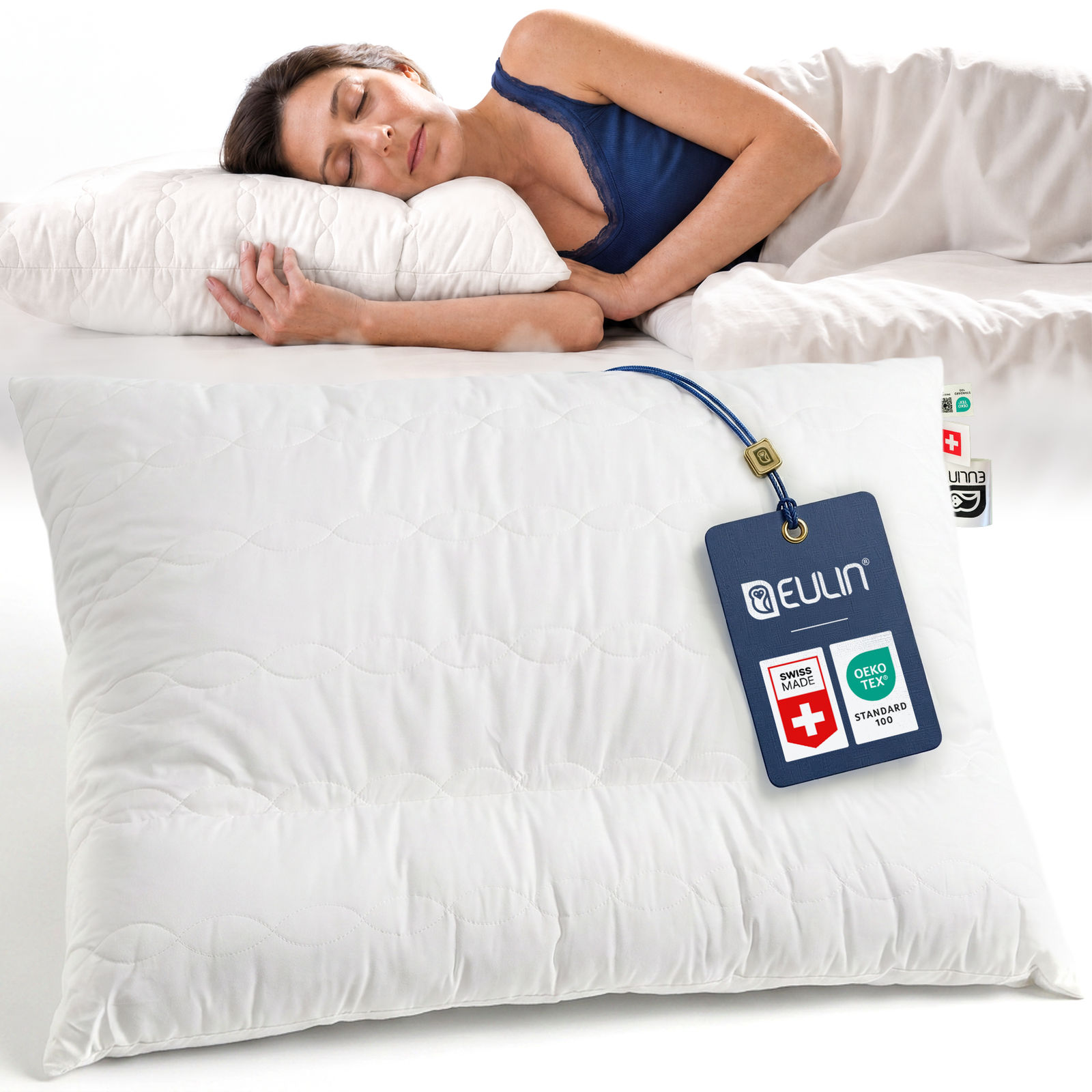
Effectiveness & Health

A pillow influences how the head, neck and cervical spine are positioned during sleep. Its most important task is to equalize the distance between the head and the mattress and to support the most comfortable, neutral sleeping position possible.

Whether a pillow is right for you depends in particular on the following factors:
• your preferred sleeping position
• your shoulder width
• your body type
• the hardness and sinking depth of your mattress
• the cushion height
• the shape and support of the pillow
• your personal comfort
Scientific reviews show that pillow height, shape and material can influence the position of the cervical spine, perceived comfort and morning discomfort. However, the study results are inconsistent. There is therefore no single pillow that is proven to be best for everyone.

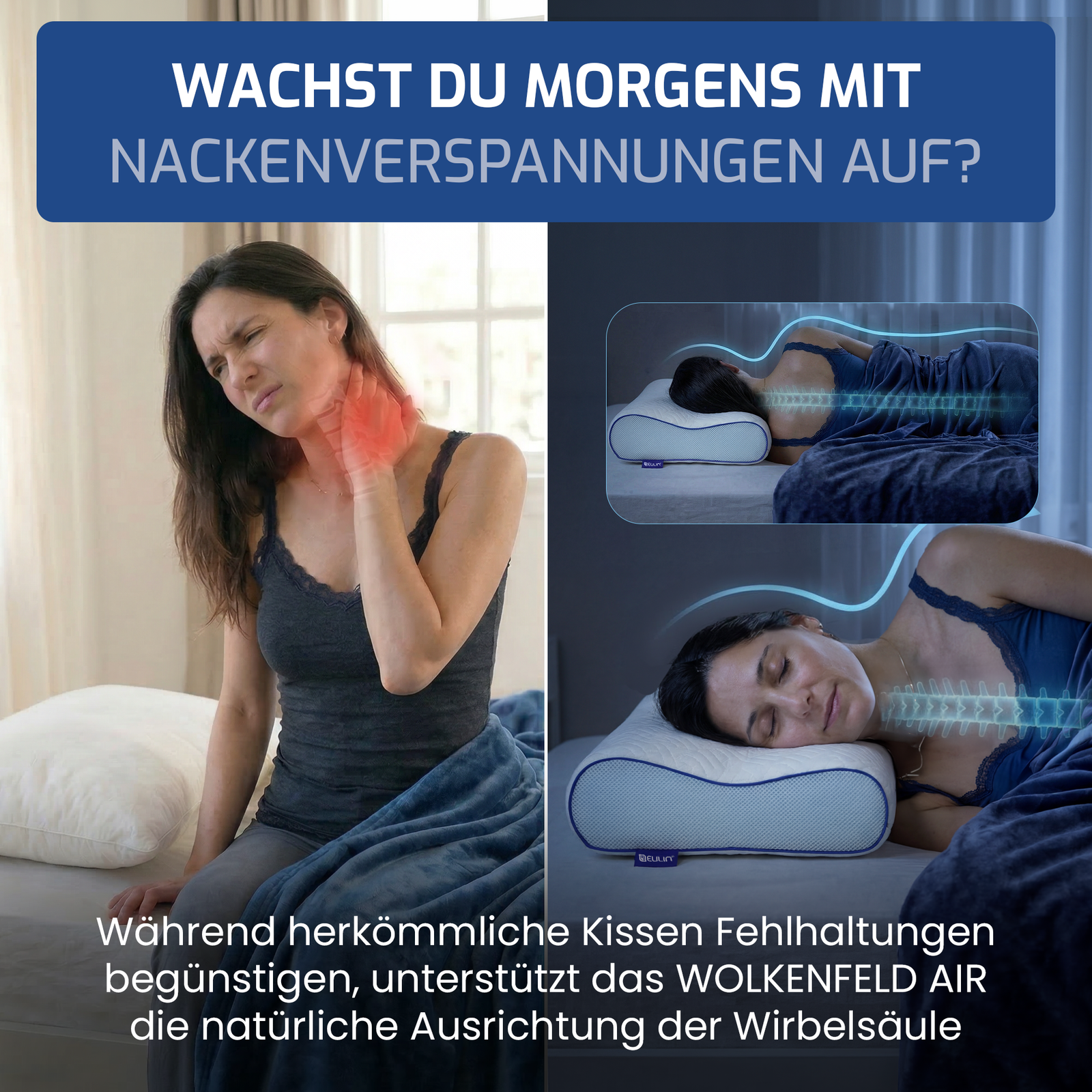
An ergonomic pillow should support the head and neck in such a way that the natural alignment of the cervical spine is supported as well as possible.
Depending on the design, an ergonomic pillow can, for example, have a neck support, a head recess, different height zones or an adjustable filling capacity.
The term “ergonomic” is not the only thing that matters. The height, shape and support of the pillow must match your sleeping position, your body type and your mattress.

The cervical spine connects the head to the torso and has a natural curvature. During sleep, the pillow should support the head and neck in such a way that no pronounced and permanently unfavorable side bending, hyperextension or bending occurs.
When lying on your side, the cervical spine should, if possible, be in an extension of the rest of the spine. When lying on your back, the neck should be supported without the head being pushed significantly forward.
There is no generally valid ideal position. The right positioning depends, among other things, on your sleeping position, your shoulder width, your body type and the sinking depth of your mattress.

A neutral sleeping position means that the head, neck and spine are positioned as naturally as possible and without any significant lateral or forward or backward deviation.
When lying on your side, your head should neither sink significantly towards the mattress nor be pushed upwards. When lying on your back, the pillow should support the natural curve of your neck without lifting your head too much.
A neutral position usually feels relaxed and creates as little unnecessary pressure or tension on muscles and joints as possible. However, it is individual and cannot be determined based on body size alone.

The pillow height largely determines how the head and cervical spine are aligned during sleep.
A pillow that is too high can push the head forward when lying on your back. When lying on your side, you can tilt your head upwards away from the mattress.
A pillow that is too flat can cause your head to sink towards the mattress when lying on your side. When lying on your back, it may not provide enough support for your neck.
Biomechanical studies show that different pillow heights can change the position of the cervical spine, neck muscle activity and perceived comfort. However, a uniform ideal height for all people cannot be derived from this.
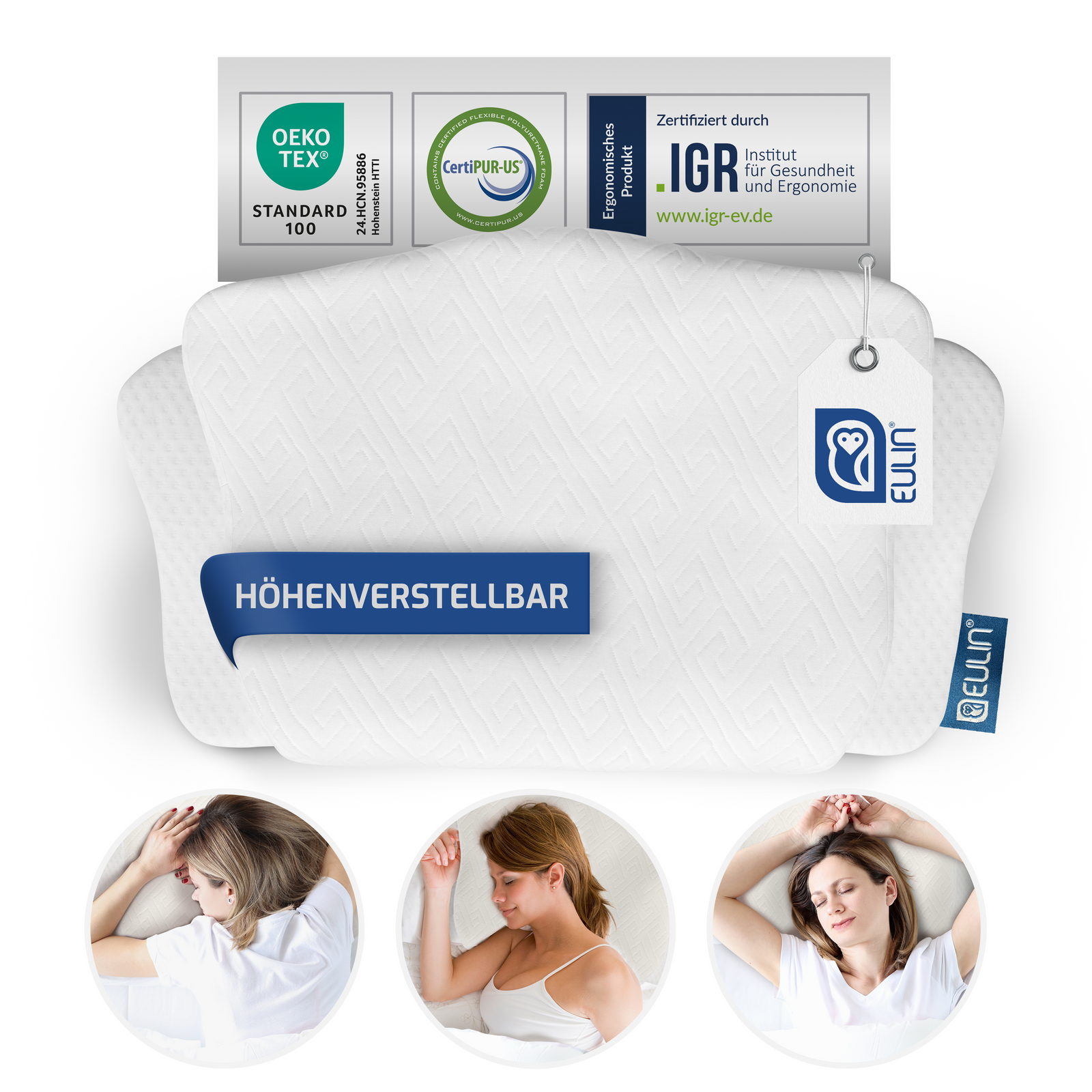
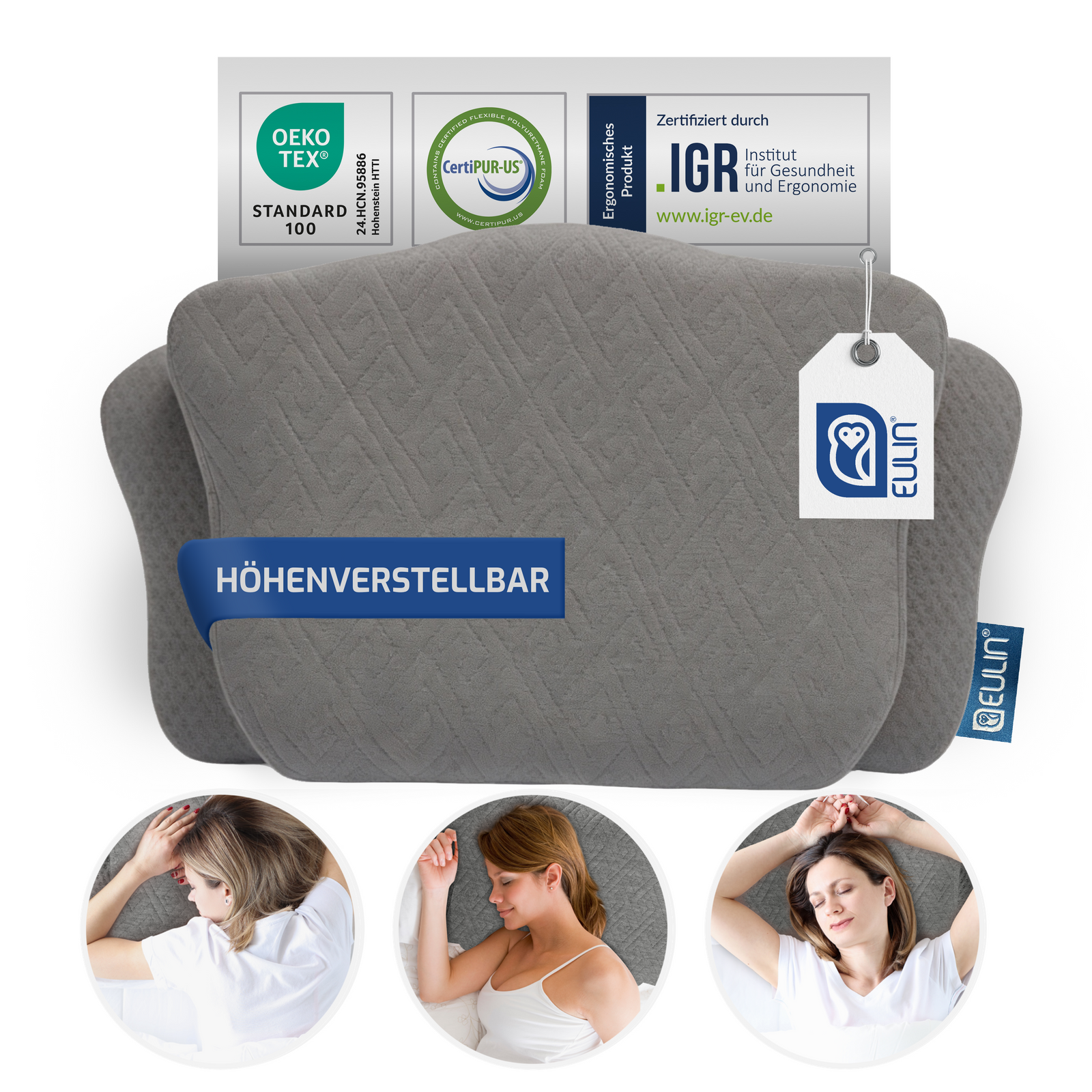
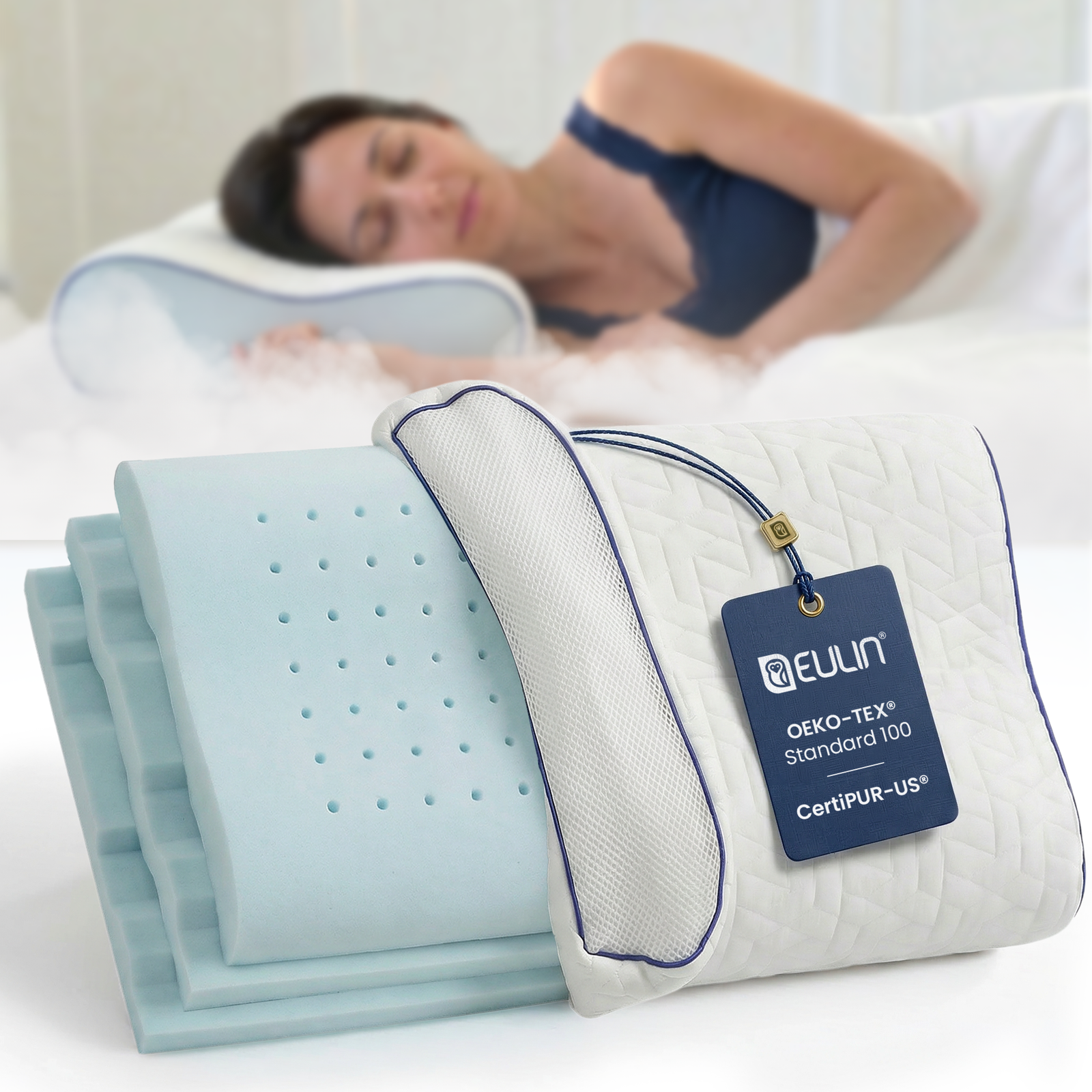
A height-adjustable pillow allows for more individual adjustment to your sleeping position, shoulder width, body type and mattress.

The correct pillow height is reached when your head is as neutral as possible to your spine in your preferred sleeping position and you feel relaxed.
For a height-adjustable pillow, start with a medium setting. Test this several nights before gradually changing the height.
Look out for the following signs:
• Your head does not tilt significantly up or down.
• Your neck feels supported but not restricted.
• You don't feel any strong pressure on the back of your head, neck or shoulders.
• You don't wake up regularly with increasing feelings of tension or pressure.
A second person can view your position from behind while lying on your side. Head, neck and back should form a straight line if possible.

A pillow for side sleepers must compensate for the distance between the shoulder and head. The wider the shoulders and the less the shoulder sinks into the mattress, the more height may be required.
On a soft mattress, the shoulder sinks deeper. This means that a lower cushion height is often required.
On a firm mattress, the shoulder stays higher. Therefore, a higher or more supportive pillow may be more comfortable.
The pillow should neither allow the head to sink towards the mattress nor push it significantly upwards.

A pillow for back sleepers should support the neck without forcing the head forward.
A medium cushion height is often suitable. However, the specific setting depends on the natural curvature of your cervical spine, your body type, the shape of your head and the mattress.
A pronounced neck support can be comfortable as long as it fits your individual anatomy. However, too much height can lead to increased bending of the head.

A pillow for stomach sleepers should generally be particularly flat. When sleeping on your stomach, your head is usually turned to the side. A high pillow can further increase this rotation and hyperextension of the cervical spine.
Some stomach sleepers sleep more comfortably with a very flat pillow or a significantly reduced filling capacity.
Since stomach sleeping can put strain on the cervical spine due to the sideways head rotation, a position that is as relaxed as possible is particularly important for each individual.

Mattress and pillow together form your sleeping system. The mattress determines how deeply your shoulders, upper body and pelvis sink. This changes the distance that the pillow has to compensate for between the head and the lying surface.
The shoulder often sinks deeper on a soft mattress. This can make the same pillow appear higher.
The shoulders sink less on a firm mattress. In this case, a higher or more supportive pillow may be required.
This is why an ergonomic pillow may feel different after a mattress change, even though the pillow itself is unchanged.

A pillow that is not properly adjusted can contribute to an unfavorable sleeping position. This can place greater or one-sided strain on muscles, joints and other sensitive structures.
A pillow that is too high, too flat, too soft or too firm can therefore promote feelings of tension, pressure or stiffness in the morning.

However, neck problems often have several causes. Possible further influencing factors are:
• Sitting for long periods of time
• awkward posture
• Lack of exercise
• one-sided loads
• Stress
• Teeth grinding
• Injuries
• Existing illnesses
• Changes to joints or intervertebral discs

An orthopedic pillow or ergonomic neck support pillow can support nighttime positioning. However, it does not replace medical diagnosis or therapy.

A suitably selected ergonomic pillow can make some people more comfortable and reduce neck pain in the morning. Whether and to what extent an improvement is evident varies from person to person.
Scientific research suggests that pillow shape, height and material can have an impact on comfort, sleep quality and neck problems. However, the study does not guarantee that a specific pillow will reliably relieve pain.
Neck pain can have numerous causes. If you have persistent, severe or recurring symptoms, you should have the cause clarified medically.

A comfortable and properly adjusted pillow can help you feel more comfortable while you sleep. A comfortable position can reduce nighttime discomfort and improve subjective sleeping comfort.

However, sleep quality is influenced by numerous other factors. These include:
• Sleep duration
• Sleep rhythm
• Light
• Noise
• Room temperature
• Stress
• Alcohol
• Caffeine
• Medication
• Health problems
• Exercise and lifestyle

The pillow is therefore an important, but not the only decisive, component of a good sleeping environment.

A clearly defined and pleasant pillow shape can help some people to position their head and neck more stably. This may reduce the need to change positions due to pressure or lack of support.
However, how often a person moves while sleeping depends on many factors. These include the sleep phase, the mattress, the room temperature, stress, physical complaints and individual sleeping habits.

A pillow can affect the position of the head and neck. For some people, changing their sleeping position can help breathing feel subjectively freer during sleep or reduce snoring noises.
However, a reliable effect against snoring cannot be guaranteed. Snoring can be influenced by, among other things, sleeping position, the anatomy of the respiratory tract, obesity, alcohol, medication, a stuffy nose or sleep-disordered breathing.
Loud, regular snoring with pauses in breathing, shortness of breath, severe daytime tiredness or morning headaches should be clarified medically. Such symptoms may indicate sleep apnea.
An ergonomic pillow does not replace a medical examination or treatment for snoring and sleep-disordered breathing.

From our experience and based on numerous customer feedback and reviews, we can say: For many users, snoring has decreased by using the WOLKENBLUM MF1. It is often the partners who first notice the change.

Memory foam conforms to the contours of the head and neck under pressure. This allows the support forces to be distributed over a larger area.
A shaped solid foam core also retains its basic shape and does not need to be shaken up regularly. This can be particularly comfortable for people who prefer consistent, clearly defined support.
However, the scientific evidence does not show that memory foam is fundamentally superior to any other pillow material.

The following factors are particularly crucial for comfort and the most suitable storage possible:
• Cushion height
• Cushion shape
• Supporting power
• Resetting behavior
• Sleeping position
• Mattress firmness
• individual tolerance

Memory foam gives way under load and adapts locally to the contours on the surface. This allows the pressure to be distributed over a larger contact area.
How strong this effect is depends on the foam formulation, firmness, pillow shape, temperature and body weight.
A more even distribution of pressure can be perceived as pleasant. However, it does not automatically mean that the pillow is suitable for every person or that it will prevent health problems.

Loose pillow fillings can be fluffed, squeezed and moved within the cover. This means they offer a flexible, classic pillow shape. However, their distribution can change during the night.
A molded memory foam core retains its basic geometry. It reacts locally to pressure without the filling material shifting within the cushion.
Which option suits you better depends on your personal preferences.
If you prefer a classic, malleable pillow, the EULIN® EDELFELD SWISS ZIP may be suitable. If you are looking for a clearly defined ergonomic shape, a memory foam model such as the EULIN® WOLKENBLUME MF1 or the EULIN® WOLKENFELD AIR may be more suitable.

Ergonomic cushion shapes divide the lying surface into different functional areas.
Depending on the model, these can include:
• raised neck areas
• Head hollows
• Shoulder contours
• Pillow sides of different heights
• Armrests
• Zones for side and back lying

These areas are intended to position the head, neck, shoulders and arms more specifically and support the most stable sleeping position possible.
However, the shape must fit your body. A pronounced contour can be very comfortable for one person, while it seems too tight, too firm or too high for another.

A new ergonomic pillow may feel unusual for the first few nights. This is especially true if you have previously used a very flat, highly deformable or significantly softer pillow.
Your body may need to adjust to a different height, support or head position. However, a fixed acclimatization period does not apply to everyone.
Adjust the height gradually and, if possible, test a setting for several nights. Don't change the height, pillow side and sleeping position at the same time every evening, otherwise it will be difficult for you to judge which setting actually suits you. However, our experience and the numerous customer feedback paint a clear picture: an adjustment period of two to three weeks can be useful so that the body can get used to a new ergonomic pillow.

An unusual feeling when lying down or slight temporary feelings of tension can occur if the position of the head and neck changes.
However, severe or increasingly painful discomfort should not be considered normal adjustment.
Stop use and check the pillow height if symptoms increase significantly. If you experience persistent pain, numbness, tingling, loss of strength or radiating symptoms, you should seek medical advice.

First check whether the pillow height suits your sleeping position and mattress. A pillow that is too high or too flat is a common cause of an uncomfortable feeling when lying down.

Proceed step by step:
1. First test a medium height setting.
2. Use the same setting multiple nights.
3. Reduce or increase the pillow height in small increments.
4. Check whether the pillow side you are using fits your sleeping position.
5. Make sure that your shoulder is not completely on the pillow when lying on your side, unless the product shape specifically states this.
6. Consider the sinking depth of your mattress.
If you experience severe or increasing symptoms, you should stop using it.

A sleep mask can reduce disturbing light. Earplugs can block out ambient noise. As a result, both products can contribute to a quieter and darker sleeping environment.
Clinical studies, particularly from hospitals and intensive care units, show that eye masks and earplugs can improve subjective sleep quality in bright and noisy environments.
These results cannot be fully transferred to every everyday situation. However, they support the fundamental principle that reducing light and noise can promote sleep comfort.

Light is an important timer for the human sleep-wake cycle. Bright light in the evening or during the night can signal the body to stay awake.
As darkness increases, natural melatonin production is stimulated. Melatonin is a hormone produced by the body that supports the sleep-wake cycle and prepares the body for sleep. A sleep mask with 100% light blocking can help create the darkest sleep environment possible and promote this natural process.
A well-darkened sleeping environment can therefore help you fall asleep and stay asleep. A sleep mask can be particularly helpful when traveling, in hotels, during shift work or in rooms without sufficient darkening.
The actual effect depends, among other things, on the light source, the individual sleep rhythm and the fit of the sleep mask.

Noises can make it difficult to fall asleep, trigger brief waking reactions or affect the perceived quality of sleep.
Earplugs can reduce disturbing ambient noise, creating a quieter sleeping environment. However, they do not produce complete silence.
How much noise reduction is perceived depends on the frequency, volume, fit, the attachment used and the individual noise sensitivity.

Earplugs must fit correctly and comfortably. They must not cause pain or strong pressure in the ear canal.
Also make sure that important warning signals continue to be taken into account. This can include smoke detectors, alarms, emergency calls or noises from people in need of care.
Clean reusable earplugs according to the care instructions. Do not continue to use damaged or dirty attachments.
If you have ear pain, inflammation, injury, recent ear surgery, or other ear canal conditions, you should seek medical advice before use.

A pillow does not replace medical diagnosis. Have neck problems checked by a doctor if they are severe, last a long time, recur or significantly affect your mobility and everyday life.

Prompt medical evaluation is particularly important if the symptoms:
• occur after an accident or fall,
• radiate into the shoulder, arm or hand,
• associated with numbness or tingling,
• be accompanied by loss of strength,
• occur together with fever,
• accompanied by severe or unusual headaches,
• accompanied by dizziness, visual disturbances or balance problems,
• increase significantly at night,
• persist despite adjustment of the cushion.

If you suddenly experience paralysis, severe neurological symptoms or severe discomfort after an accident, you should seek medical help immediately.

No. A pillow can support appropriate positioning, but does not replace a medical diagnosis or medical, physiotherapy or other therapeutic treatment.
If you have existing illnesses, after operations, injuries or persistent symptoms, the choice of pillow should be discussed with a medical professional.
This is particularly true if there are special positioning requirements or if you suffer from diseases of the spine, nerves, respiratory tract or shoulder region.

Search
Frequently searched